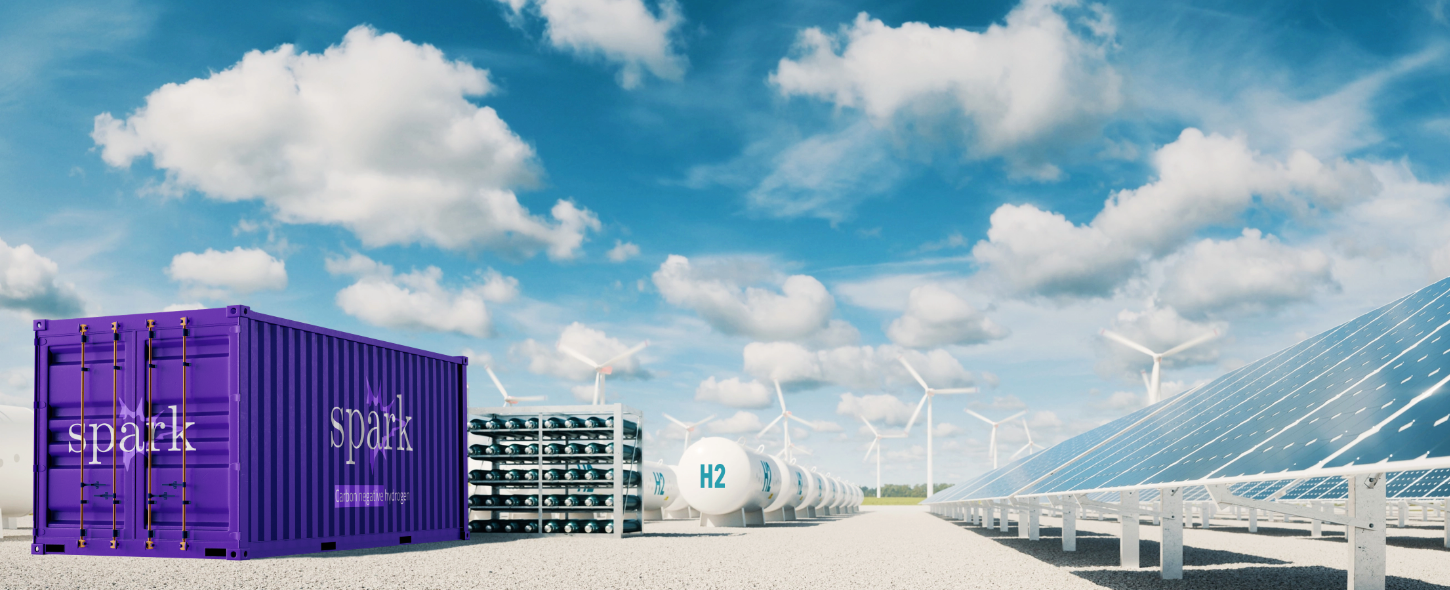
1. In the wake of the energy transition: low-carbon hydrogen, its promises and prospects
The exponential global demand for hydrogen
The hydrogen market has been growing steadily for two decades:
Indeed, its applications are numerous: heavy transport mobility (trains, buses, ships, aircraft…), heat and energy production for buildings, industrial uses… Hydrogen is everywhere, and the growth outlook for this market is widely agreed upon.
Hydrogen is a promising energy carrier for the ecological transition, but its current production relies primarily on CO2-emitting processes. This leads to a paradox: despite its central role in energy decarbonization strategies, hydrogen production remains one of the most polluting industries today:
The potential of hydrogen as a decarbonized energy source
The great challenge of the energy transition is finding ways to produce decarbonized energy at scale. Hydrogen holds part of this promise: when used as a fuel, hydrogen emits no CO2. But producing this hydrogen in a decarbonized way remains the key hurdle.
Today, there are two pathways for producing hydrogen:
The first pathway is methane oxidation through reforming, which does produce hydrogen at a competitive price, but emits enormous amounts of CO2: with this method, 10 tons of CO2 are emitted for every ton of hydrogen produced.
Problem: today, this production method is facing accusations of greenwashing. And rightly so: it claims to be carbon neutral when combined with capture and storage of the CO2 emitted. But carbon capture and storage is a solution with clear limitations—we simply don't have the geological reservoirs or the capacity needed to permanently store hundreds of millions of tons of gaseous CO2 underground.
The second pathway is water electrolysis, using a renewable or nuclear energy source. This production method is as decarbonized as the electricity source chosen to power the reaction process.
Problem: this method requires enormous amounts of electricity—an estimated 7% of France's total electricity production would be needed to decarbonize this single energy source. On top of that, costs remain high: roughly €6 to €10 per kilogram of hydrogen produced.
The necessary third way and its promises
Among the more sustainable alternatives, turquoise hydrogen stands out for its low electricity consumption and its ability to utilize methane from renewable sources. The process involves producing hydrogen through methane pyrolysis—heating it to high temperatures in the absence of oxygen, which causes it to decompose into hydrogen and solid carbon black. The latter can be used as a material or sequestered.
Methane pyrolysis can be achieved through various technologies, but one of the most efficient and innovative is plasma-based. Plasma is an ionized gas with exceptional electrical and thermal properties. It heats methane to very high temperatures in just milliseconds, promoting the pyrolysis reaction while minimizing the formation of unwanted and polluting byproducts. This third pathway is what Spark Cleantech is developing today.
2. Nanopulsed plasma: the technology Spark brings to produce decarbonized hydrogen at scale
Spark Cleantech's technology uses nanopulsed cold plasma to convert methane (CH4) into value-added products.
The process is called plasmalysis:
Plasma is an ionized gas generated by electrical impulses. Plasma discharges are used to perform methane plasmalysis: electrons are created, accelerated, and collide with methane molecules to dissociate them.
The plasma discharges are placed under thermodynamic non-equilibrium, meaning that the electrons are far more energetic than the gas itself: molecules can therefore be dissociated without excessively heating the gas, which increases the energy efficiency of the process.
The products of plasmalysis are hydrogen (H2) and carbon black. Hydrogen is a clean energy carrier that can be used for mobility, industry, or power grids. Carbon black is a material with remarkable properties that can be used in the manufacture of tires, batteries, or composite materials.
The competitive advantages of the Spark solution
Spark offers several advantages:
Electricity consumption: Spark uses nanosecond cold plasma, a unique and patented technology that controls plasma temperature to achieve a fast, efficient reaction with low electricity consumption (10 kWh/kg H₂)—even at small scale.
Lowering the price of decarbonized hydrogen: Spark offers decentralized, modular hydrogen production directly at the point of consumption, eliminating the costs and constraints of hydrogen transport and storage. Additionally, monetizing the solid carbon byproduct from the reaction brings the price of decarbonized hydrogen down to parity with carbon-intensive hydrogen.
"Our process will enable the production of cost-effective hydrogen, even at small capacities for future hydrogen refueling stations, for example, but above all to meet the needs of industrial applications, directly at the point of use—thereby eliminating the transport and storage constraints that can account for up to 70% of total costs," summarizes Patrick Peters
Modularity and decentralization: Spark's solution is modular and can be deployed in a decentralized manner, enabling it to address a wide range of use cases—including on-site hydrogen needs as small as a few hundred kilograms.
Zero CO2 emitted during the process: the only carbon produced by plasmalysis is pure carbon in solid form, which is 3.7x lighter and 220x less voluminous than CO2—making it easy to sequester with no risk of leakage.
Behind the project: an ambitious, highly skilled and deeply complementary team
At the origin of the Spark project, there's first Erwan, who developed pulsed cold plasma technology for energy applications during his PhD at Paris-Saclay. Patrick then brought to the project his operational expertise gained both within large corporations (Suez) and successful deep tech startups (Adionics).
A complementary team, then, but also an ambitious one:
"We aim to reach the market with our first units as early as 2025, following an industrial pilot phase in 2024" - says Patrick Peters
Today, Spark is a team of 8 PhD students and entrepreneurs who share the same vision: leveraging the technologies developed in their research labs to make a meaningful impact on the environment.
3. A revolutionary process that has just entered its industrialization phase
Competitions and projects won
From the very start, Spark Cleantech was selected by GRDF (2021) through a call for projects dedicated to industrial decarbonization. Last year, Spark also won the Grand Prix (€500k) at the i-Lab 2022 competition organized by Bpifrance and the French Ministry of Higher Education.
Technical breakthroughs
The young company is just entering its industrialization phase: Spark has completed a 3-year R&D program that led to the production of two unit cells sized for 1 kg H2/day. Spark is currently designing its first industrial demonstrator for deployment in late 2023, and a pilot project that will operate under on-site conditions, with deployment planned for 2024.
Next steps and use of funds
For all these reasons, we are very proud to enable Spark Cleantech to make key hires to strengthen its team and accelerate its industrialization.
The Spark project as told by Erwan Pannier, Co-founder:
We're in the press:
"Hydrogen production: Spark announces a €4 million raise", Maddyness
"Another path to producing green hydrogen," Les Échos