A model at the intersection of multiple markets
1.1. Consumer packaged goods: a massive market
Through its innovative shared-giving products, Ramdam Social is targeting the massive retail market. The startup is focusing on three sectors, tackling one new category each year: food (2024), hygiene products (2025), and beverages (2026). These markets are valued at €2.9B, €760M, and €579M respectively.
While this market is obviously dominated by major food industry conglomerates, it's so vast that the marginal share left to innovative products with an original positioning easily represents over a hundred million euros.
Furthermore, the mass retail market also values solutions with a positive impact across various dimensions. Its presence at the heart of everyday life makes it a significant societal issue.
1.2. Donations: an ecosystem driven by a wealth of innovation
The relationships between companies and nonprofits have undergone significant changes in recent years, evolving from adversarial dynamics to increasingly sophisticated partnership models. This reflects a broader trend: in 2021, companies reported €2.3 billion in charitable donations to French tax authorities (source)
Among these innovations, we can point to "no-cost giving"—donations that cost the consumer nothing—as well as "embedded giving," which involves contributing a very small amount, either deducted from or added to a transaction, that then benefits a cause. This includes checkout and payroll roundups, which have been gaining traction in France, now reaching €50 million per year.
The appeal of this type of donation lies in the simplicity of giving through these mechanisms—for example, at checkout—and in the small amounts involved. Since its inception, MicroDON has collected over €60 million.
1.3. Shared-revenue products: from marketing tool to a new model for responsible consumption
This practice, though still uncommon, is gaining traction in France. Known by various names—"cause-related products" or "cause marketing"—it doesn't yet have an official definition, though in practice it refers to the sale of "a product or service where a portion of the price is donated to a public interest organization in exchange for the company's right to use that organization's name in its communications" (Admical).
There are a few examples of this type of marketing initiative, notably the Unicef and Volvic partnership "1 liter purchased = 10L drawn in Africa" or more recently the "Panda phone," a partnership between Back Market and WWF France.
Product sharing thus aligns with this consumer trend toward seeking more socially responsible and ethical products.
Among the product-sharing brands cited as examples, Germany's Share is certainly the best known: €40 million in revenue last year and over 140 million humanitarian aid actions since its 2018 launch, reaching more than 2.6 million people through social projects in Germany and around the world.
Ramdam Social, the first category entirely dedicated to cause-related products in France
2.1. Sharing at the heart of the Ramdam Social model
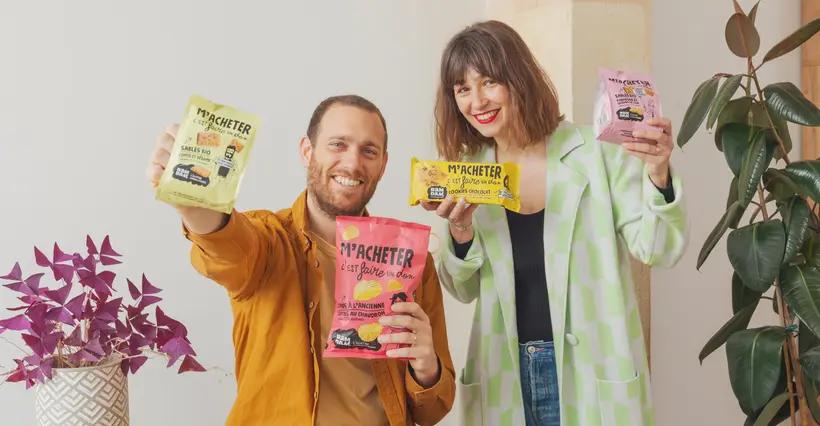
Unlike temporary initiatives such as those from Volvic or BackMarket, Ramdam Social's entire business model is built around giving. Every sale generates a concrete donation to a pre-selected charity, representing 7% to 10% of revenue. To achieve this, the startup partners with several organizations including Secours Populaire, Samusocial, and food banks.
For a bag of chips, for example, Ramdam Social funds the distribution of a snack (a hot drink, a biscuit, or a soup) during street outreach rounds or at daytime drop-in centers.
Over time, Ramdam Social aims to diversify its social impact product range by tackling different forms of precarity: food insecurity first, then hygiene, digital access…
2.2. A committed and experienced team
The Ramdam Social team is made up of its two founders, Julie and Olivier. They combined their shared ambition to make charitable giving easier in France with their extensive experience in the responsible consumption sector:
- Julie: she handles marketing. Julie brings varied experience as Marketing Director at Innocent and Happyvore.
Luc-Olivier handles the commercial side. He previously held commercial leadership positions at Bel and Too Good To Go.
An obvious social impact and the ambition to spark a real revolution
The Ramdam Social project grew from a simple observation: solidarity, as we conceive it today, often remains dependent on charity—a voluntary, one-off gesture. To be effective at scale, it needs to become a reflex, an integral part of everyday life. Ramdam Social's vision is straightforward: every purchase, every daily action can carry solidarity, without extra effort or sacrifice.
For 2024, Ramdam Social's ambition is to generate 250,000 food donations ranging from 10 to 25 cents each, before scaling nationwide in 2025.
But Ramdam Social's impact goes beyond financial generosity—the company is also committed to sustainable farming practices by working with local producers who are paid a fair price. Ramdam Social's medium-term ambition is to develop the local economy to create jobs.
By innovating in how we think about giving and consumption, Ramdam Social aspires to become a model for other companies looking to combine economic performance with social responsibility, while raising consumer awareness about poverty-related issues.
Featured in the press:
Maddyness