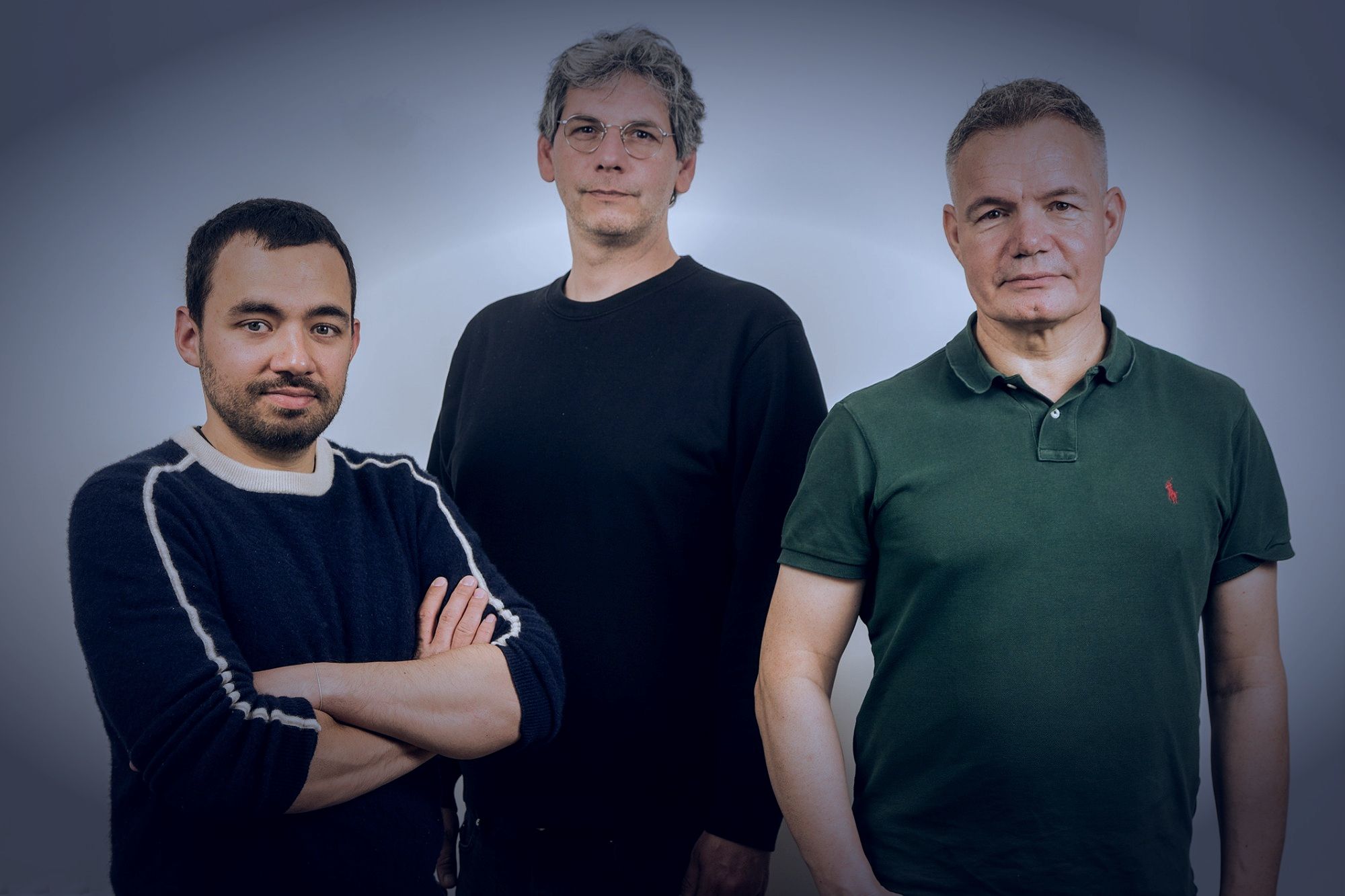
The French-American startup announces a €6.5M seed round, co-led by Asterion Ventures, Galion.exe and GrainCorp Ventures, with participation from Pascual Innoventures, Kima Ventures, Station F and Exponential Impact.
The goal: to develop foundation models trained on DNA, RNA, and multi-omics data to accelerate crop breeding and, ultimately, decode life itself.
AI Applied to the Language of Life
Every living thing on Earth runs on the same code: DNA encodes RNA, RNA encodes proteins, proteins encode phenotype. Living Models trains neural networks on these biological sequences, using the same transformer architecture that powers large language models.
The difference: instead of learning from human text, the models learn from genomic sequences. They develop representations of living systems that can then be specialized for concrete applications, from trait discovery to variety selection.
The company intends to follow the data wherever sequence-based discovery is held back by slow empirical methods, whether in agronomy, marine biology, or human health.
BOTANIC: Initial Results
Living Models' first model, BOTANIC, was trained on 43 plant species representing over 60 billion base pairs.
The results published in a technical report are clear:
performance comparable to InstaDeep (acquired by BioNTech for $680M, over $100M raised) and Cornell across 22 standard benchmark tasks, training completed on just 8 NVIDIA H100 GPUs, consistent improvements as model size scales (up to 1 billion parameters).
The announced funding provides access to a dedicated cluster of 120 NVIDIA B200 GPUs: an order-of-magnitude leap in computing capacity that the company plans to translate directly into larger models and increased predictive accuracy.
Why start with agriculture
The global seed market is worth €55 billion. It's dominated by a handful of players (Bayer, Corteva, Syngenta, BASF, Limagrain) who collectively spend €7.5 billion per year on plant breeding—using methods that haven't changed in sixty years.
The reality is stark:
eight years on average to create a new variety, pathogen resistance genes bypassed within three to five years, yield gains of 1% per year—insufficient to meet 2050 food demand, the 2024 heatwave reduced French wheat yields by 15%, over €2 billion in losses.
BOTANIC compresses the selection cycle to two to three years by generating trait predictions computationally. The model doesn't replace the laboratory or the field—it intervenes upstream, where plant breeders choose among thousands of possible crosses, focusing effort on the most promising leads.
Beyond the urgency, agriculture offers structural advantages for a foundation model company: no GDPR or HIPAA restrictions on plant genomic data, regulation that only kicks in after efficacy is demonstrated, and a fast validation cycle (three to six months in a greenhouse, compared to over ten years for a clinical trial).
A Franco-American team
The company was born between Paris and Berkeley. The cofounders bring together geographies and disciplines:
Cyril Véran (CEO): UC Berkeley, serial entrepreneur in agtech, former founder of Smart Farming System. Léonard Strouk (CTO): ENS alumnus, biochemistry research at UC Berkeley and NYU, founder of a previous generative AI company. Bertrand Gakière (VP Biology): Université Paris-Saclay, expert in plant physiology and metabolism.
The technical team includes PhDs from Owkin (a Paris-based specialist in AI applied to drug discovery, with over $300M raised), Huawei Noah's Ark Lab, Datadog, Mila, and École normale supérieure.
Why we're backing Living Models
In our latest AI for Life essay, we laid out a framework: AI must be funded within the boundaries of the living world. Living Models is the most direct illustration of this principle.
What convinced us is the clear-headedness of their approach. The team doesn't oversell their technology. They know the real challenge isn't building a bigger model, but earning the trust of seed companies and integrating into their workflows.
Adoption by large corporations will take time. But the approach is scientifically sound, the team has the technical depth to execute, and the need is there.
At Asterion Ventures, we invest in AI where it strengthens the systems that support life. Living Models is building infrastructure capable of accelerating crop breeding in the face of climate change, reducing dependence on chemical inputs, and tomorrow expanding into other biological domains.
A project rooted in French research, with global ambitions. We're proud to back this team.
Learn more: livingmodels.ai
Technical report: available on BioRxiv
BOTANIC Models: available on HuggingFace