Agriculture, a sector in transformation
Agriculture emits carbon, but it can also store it
While agriculture is responsible for 25% of global GHG emissions, it is also part of the solution, through its dual capacity to significantly reduce its emissions and store carbon in soils.
This is made possible by implementing agroecological practices that follow regenerative agriculture principles, such as:
cover cropping between growing seasons, partial substitution of mineral fertilizers with organic fertilizers, returning crop residues to the soil
Beyond their carbon impact, these practices also offer numerous benefits for both farmers and nature:
they make soils more fertile, they facilitate water retention, they increase erosion resistance, they reduce dependence on inputs, they enhance biodiversity, …
Carbon farming is a promising niche within carbon offsetting
The carbon offsetting market is divided into two parts:
the regulated market (i.e., carbon quotas) on one hand, and the voluntary market on the other.
The latter reached €2B in 2021, and growth forecasts for 2035* are 120x (including 30x in credit volume and 4x in value per credit, according to Ernst & Young).
Carbon Farming belongs to the "nature-based solutions" segment of the voluntary carbon offset market, which also includes reforestation, currently the dominant category.
Carbon Farming offers numerous advantages that should drive its growth in the years ahead.
Moreover, the choice to prioritize agricultural projects over forestry projects now appears essential.
Forest cover has already increased significantly in recent decades, primarily as a result of agricultural land abandonment.
It is becoming essential to preserve agricultural land, particularly with a view to food resilience.
Today, France has 400,000 farms, covering a Utilized Agricultural Area (UAA) of nearly 30 million hectares.
The carbon reduction and sequestration potential is approximately 1 carbon credit per hectare per year, representing 30 million carbon credits annually (equivalent to the current annual emissions of 3.5 million French citizens).
With carbon credits currently valued at €45, the potential French market represents €675 million per year in funding for farm transitions—a figure expected to grow significantly by 2027, driven by rising carbon credit prices on the offset market (see the detailed Ernst & Young study from May 2022 here).
Growth opportunities in Europe are significant, with 170 million hectares of utilized agricultural area primarily concentrated in major farming countries such as Spain, Germany, Italy, Poland, Romania, and England.
Carbone Farmers maximizes value across the entire supply chain
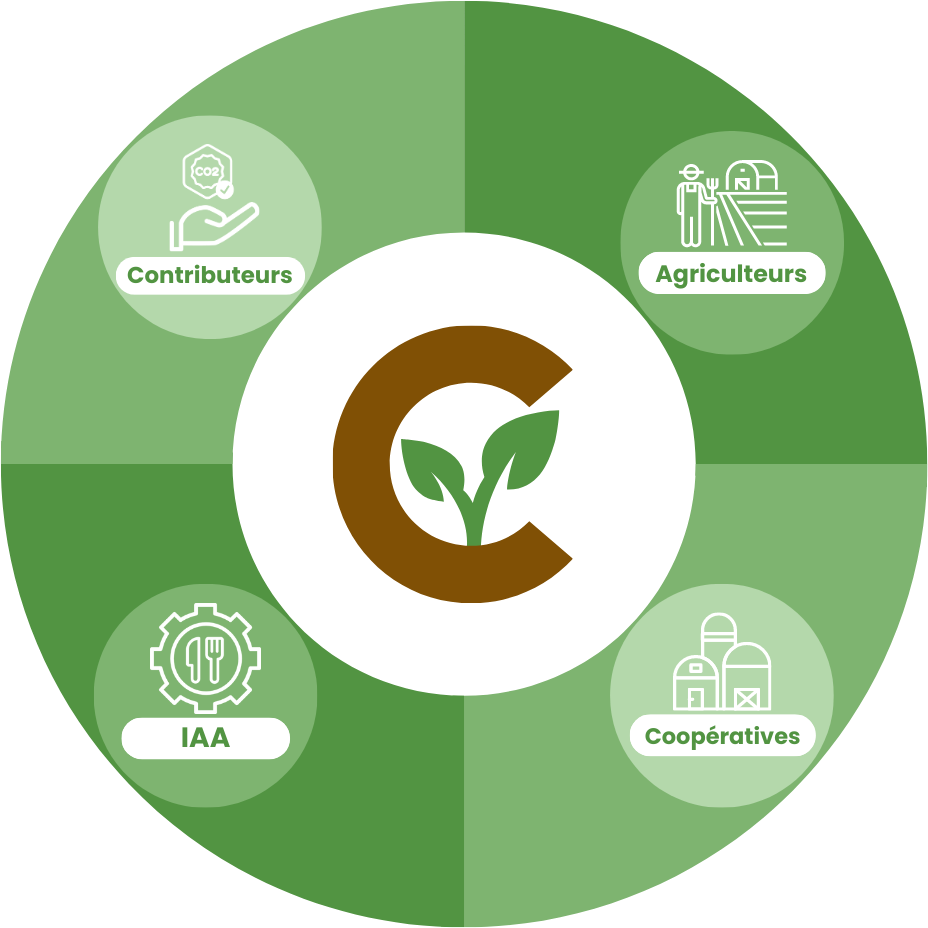
The model is designed to benefit every stakeholder
It benefits from:
recommendations on practices to implement, better financing through Carbon Credits (75% of the carbon credit value versus 65% with other market players), and a precise analysis of transition costs that provides evidence to transition funders
It has:
of a solution compatible with all types of crops and farms, of compensation of €200/year/farm plus 1.5% of carbon credit sales, and of support for cooperative sales technicians on projects along with alignment of specifications around a multi-sector approach.
They have access to:
better traceability through a single SaaS platform for tracking emission reductions, and unmatched transparency thanks to data collected from all the tools deployed
More than 300 farmers and a major French company already on board
Carbone Farmers has already won over 4 cooperatives and several major corporations involved in the agri-food value chain
In total, more than 300 farmers have committed to the solution. They are primarily in field crops, currently in the upstream implementation phase (carbon potential assessment), then by the end of 2022 in the project phase with the start of commercialization of generated carbon credits.
On the carbon credit buyer side, Carbone Farmers won a competitive tender open to all players developing carbon offset projects in France with one of the largest carbon credit buyers in the country, representing nearly 2.5 million tCO2e. This is an exclusive 3-year partnership.
In any case, customer feedback from both farmers and corporates has been extremely positive:
"For many years now, I've paid close attention to the health of my soil, and it's paid off. So when you told me about funding tied to practices I already wanted to implement, I naturally listened carefully. I chose Carbone Farmers because beyond understanding farmers' challenges and being available, you're transparent about the process. I know I receive 75% of the funding with payment right from the start of the first year."
Bertrand Ravillon, farmer in Marne (51)
"Our group, which has been involved in regional projects and carbon offsetting in France since 2015, has been working with Carbone Farmers since spring 2022 to benefit from their expertise in supporting innovative agricultural projects that create value for local communities while delivering strong social and societal co-benefits."
Elodie R., Head of CSR
This excellent field feedback, combined with strong differentiating factors, leads us to believe that Carbone Farmers will be one of the big winners in this market. Even more so when you factor in the impact potential.
The positive impact is proven
Carbone Farmers addresses the urgent challenge of climate change by acting on two levels:
The reduction of emissions from the agricultural sector, which accounts for 25% of GHG emissions, and agricultural resilience in a context of climate disruption and the pursuit of food sovereignty
A lasting impact with no risk of greenwashing
This is made possible through a certified and traceable approach at multiple levels:
carbon credit issuance is certified by Bureau Veritas. The audit methodology covers all farms with annual pre-certification that goes beyond regulatory requirements (which only mandate an audit after 5 years)funders have access to detailed annual reporting on carbon trajectories achieved versus initial targetthe company includes tracking of non-carbon indicators that are essential to securing impact: biodiversity, soil, water
Controlled costs and a fairer distribution of value
Carbone Farmers enables food companies to decarbonize their supply chains at a controlled cost.
The model distributes transition funding between:
carbon credits, which are sold outside the value chain to companies looking to contribute to the transition.
supply chain premiums, distributed equitably across the farmer's various market outlets, as compensation for actual carbon emission reductions.
What are sector premiums?
Supply chain premiums are a "premium" paid by manufacturers to their suppliers in exchange for compliance with specific requirements.
Examples: organic, pesticide residue-free, non-GMO, maintenance of ecological focus areas, etc.
In the case of carbon, this is a premium calculated based on the effective reduction of the carbon footprint of supplies, which we will calculate for each value chain (wheat, barley, corn, rapeseed, etc.).
For example, the carbon footprint of a yogurt can be reduced by nearly 30% through the implementation of agroecological practices.
Carbone Farmers offers a fair distribution of the value created by carbon farming:
Farmers receive 75% of the carbon credit sales value—the highest share on the market—and boost their income through value chain premiums
cooperatives are compensated for farm monitoring, strengthening their relationships with farmers through secured low-carbon supply contracts
the agri-food industry reduces its carbon footprint at controlled cost
carbon credit buyers invest in high-impact projects with strong traceability.
By 2027, in France alone, the company could enable the transition of 800,000 hectares of farmland to regenerative, low-carbon practices—an area the size of the Marne department—representing nearly 4 million Carbon Credits, equivalent to the annual carbon footprint of 400,000 French citizens, or a city the size of Toulouse.
This is equivalent to the sale of nearly 1,300,000 carbon credits, representing cumulative direct financing for farmers of over 40 million euros.
For all these reasons, we are very proud to enable Carbone Farmers to accelerate the deployment of its solution through targeted hires and increased visibility with cooperatives and carbon credit buyers.