The concentrated, specialized farming model is running out of steam
Negative externalities are forcing a rethink of agricultural practices
The vast majority of negative externalities (biodiversity loss, greenhouse gas emissions, water pollution, soil erosion, etc.) attributable to the agri-food sector at large originate upstream in the supply chains, at the production stage.
For example, agricultural production accounts for 67% of the sector's carbon emissions.
While this structure doesn't exempt the other links in the chain (processing, logistics, distribution, etc.) from becoming more efficient and resource-conscious, the major challenge clearly lies in driving the evolution of farming practices at the farm level.
Agronomists, researchers, and think tanks agree on the need to move away from mechanical and chemical approaches—still widely used today—toward a model grounded in a deeper biological understanding of agricultural systems and respectful of natural ecosystem dynamics.
The necessity of an agroecological transition
Within each region, on each farm, production must therefore diversify to become complementary—calling for the establishment of a local food system that is more sustainable and resilient.
Micro-dairies: an excellent starting point for agricultural renewal
Dairy products in France represent a massive market undergoing a major transformation.
In France, the dairy market was valued at €39 billion in 2020, representing one-fifth of the agri-food sector.
With a penetration rate close to 99%, these are everyday products. Nearly 80% of French people consume at least one dairy product per day.
It is undergoing a major transformation and moving upmarket, as evidenced by the decline in volume over the past 5 years (-5.8%), offset by an increase in value (+5.8%) over the same period.
There are now many players on the market offering plant-based alternatives (milks, yogurts, and even ice creams).
While these companies help consumers shift toward plant-based diets, they rarely claim the ambition to support the transition of upstream agricultural supply chains.
Yet, to drive systemic transformation in the agri-food sector, it's essential to move beyond a "product" mindset and embrace a "production method" approach—bringing all stakeholders together around a shared transformation project.
Specialized organic retailers don't really have a suitable range of local dairy products.
There is strong demand from ecosystem stakeholders.
Many consumers and retail players are looking to stock brands and products that are more respectful of people, animals, and the environment.
Among them, specialized organic retailers (organic supermarket chains) like Biocoop and La Vie Claire, facing competition from mainstream supermarkets, are showing strong demand for products that are both organic AND local—as evidenced by Naturalia's latest advertising campaign.
Indeed, the perception of organic's value proposition has been declining for some time and is no longer enough to convince consumers.
Local products are picking up the slack.
Consumer appetite for local products is indeed growing stronger.
🌿 More than 9 out of 10 French consumers associate local products with responsible consumption—11 points higher than "Made in France."
📈 41% of French consumers "often" buy local products. With an 8-point increase, this was the fastest-growing purchasing criterion across all categories in 2020.
🧒 73% of young people aged 15 to 30 consider it important to know where the products they consume come from. As this trend primarily affects younger generations, it's here to stay and will only grow stronger in the years ahead.
Today largely stocked with local grocery products (beers, biscuits, etc.), organic store managers are looking for a local offering for their fresh sections that is truly suited to their needs and aligned with their constraints—particularly in the dairy segment.
Among the challenges posed by GSS Bio are:
The exclusivity requirement: a brand cannot be listed in both organic and mainstream retail channels.
Just-in-time supply: often located in city centers, organic stores have limited space for storing goods and consequently need regular deliveries. For the same reason, they're typically far from on-farm processing facilities, which are nonetheless growing in number. Finally, cold chain costs represent an additional challenge in establishing such a logistics circuit.
A partner sales service: managing order-taking from multiple local suppliers requires more time than going through the retailer's central purchasing unit. To accelerate the listing of local products, department managers expect their suppliers to provide operational support in managing the commercial relationship—from order-taking to invoicing, including scheduling promotional events.
That's why Bon Dimanche has developed and now offers a tailored solution designed specifically for the organic network.
Bon Dimanche offers an original solution: micro-dairies
The micro-dairy enables local production of dairy desserts
The model developed by Bon Dimanche involves deploying and operating its own network of decentralized micro-dairies, each located on the outskirts of a major French city.
To source their milk, each micro-dairy partners with nearby organic and committed dairy farms (between 2 and 4).
It collects fresh whole milk from these farms once a week before processing it.
Downstream in the supply chain, the company contracts directly with organic store managers located within a 150 km radius to supply them with dairy products.
The key to success lies in the joint deployment of a dual product range:
premium ice creams designed to generate value,
ultra-fresh products (dessert creams and yogurts) designed to generate volume and repeat purchases.
All of this built around a strong brand: Bon Dimanche
Bon Dimanche's ambition is to become a strong brand, emblematic of a local processing and distribution model.
The project takes shape as a brand of delicious, local dairy products (made within 150km of their point of sale) that supports agroecological farms in the region.
While local sourcing is the main differentiating factor, the company has built its approach around 6 key pillars listed below:
😋 INDULGENCE: rich, aromatic products crafted from recipes using fresh whole milk and carefully selected ingredients.
🌱 NATURALNESS: a short ingredient list, 100% organic, with no additives or ultra-processed ingredients.
📍 LOCAL: a dairy that works directly with farmers and stores within a 150 km radius.
🤝 FAIR TRADE: milk certified organic and fair trade in France, with 100% of North-South sourced ingredients carrying fair trade certification.
♻️ ECO-DESIGN: recyclable packaging, processes and products designed to minimize their environmental impact.
👪 CONVIVIALITY: A wide variety of products and flavors, packaged in large formats designed for sharing.
The ambition is to establish new consumption standards and become one of the flagship brands of the agroecological transition.
The first range of ice creams delivers on its promises
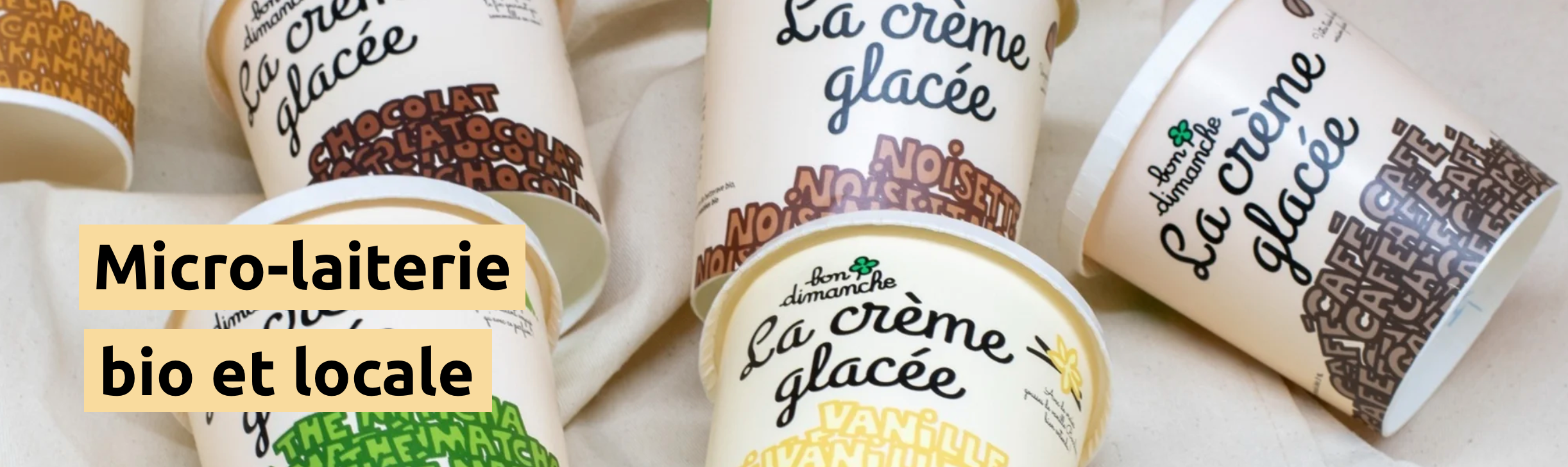
Bon Dimanche currently sells 4 ice cream flavors crafted from exclusive recipes—the secret to their success!
Known for their smooth texture and intense flavor, the recipes are systematically tested with a consumer panel before going to market.
The products are packaged in a single format (400mL jar) to limit packaging impact and simplify industrial processes, with the goal of eventually moving toward a deposit return system.
The company has already won over 41 organic stores in Paris and the surrounding area with this first range of dairy desserts.
They order and reorder the products regularly.
Customer and retailer feedback has been excellent, as shown in the photo below.
The company was being approached by other stores, but until February 2023, it was limited by its production capacity—which is no longer the case.
Since February 2023, Bon Dimanche has set up its first micro-dairy in Saint-Nom-La-Bretèche.
And they're not stopping there—the company is aiming to open 11 micro-dairies within the next five years!
Impact at the heart of the model
Impact is at the heart of Bon Dimanche's model and is embedded at every link in the value chain.
Impact means:
Ensuring rewarding market opportunities for dairy farmers
The goal is to engage them in the agroecological transition of their farm.
Indeed, after several years of rapid conversion to organic farming, the supply of organic dairy products has recently caught up with demand, and the industry is now seeking new outlets to continue its transition.
In 2021, over 30% of organic milk was downgraded to conventional channels, triggering a significant price drop that now threatens the efforts and plans of many producers…
The mission guiding the two founders therefore centers on developing new business models that create genuine value in consumers' eyes, enabling dairy farmers committed to the agroecological transition to earn a fair price for their production.
Deploying a sustainable and resilient business model: 100% organic, local, and fair trade.
Bon Dimanche works with Coopérative Biolait, the leading organic milk collector in France, bringing together over 1,000 agroecological dairy farms across the country around a shared mission:
"Organic for everyone, everywhere."
Sincerely committed to sustainable agriculture, the cooperative's specifications go far beyond the requirements of organic certification with
an average grazing period of over 250 days per year for its animals, 100% French-sourced feed, and a genuine commitment to biodiversity, as demonstrated by its partnerships with several naturalist organizations such as La Ligue pour la Protection des Oiseaux (LPO).
By contracting directly with farms in the network, Bon Dimanche set out to establish a complete, functional logistics system for each micro-dairy within a maximum radius of 150 km.
This local model eliminates the vast majority of long-distance logistics flows, which account on average for 50% of greenhouse gas emissions in food transport, and makes it possible to confidently transition last-mile logistics to electric vehicles and soft mobility solutions (insulated cargo bikes, etc.).
Finally, since last year, Biolait milk has joined the Bio Equitable en France label, a true guarantee of fair prices for producers.
Additionally, 100% of ingredients sourced through North-South trade, such as cocoa and coffee (5% of supply volumes), are certified fair trade under the Biopartenaire, Max Havelaar, or Fair For Life standards.
For real food, against ultra-processed
For several years now, ultra-processed foods have been at the heart of nutrition debates due to their role in the development of chronic diseases (cardiovascular diseases, obesity, etc.).
Ultra-processed foods contain ingredients that have been broken down and then reconstituted (invert sugar, corn syrup, soy protein, wheat gluten, etc.) along with numerous additives (xanthan gum, acacia fiber, etc.) with no nutritional value—their sole purpose being to improve taste, appearance, and texture.
In France, 69% of food products available in supermarkets are ultra-processed, according to SIGA, a company that developed an index measuring the degree of food processing.
Bon Dimanche is committed to eliminating all markers of ultra-processing from their recipes.
It's with this exacting standard that they developed the first range of ice creams free from additives or ultra-processed ingredients, while still guaranteeing retail customers a sufficiently long shelf life of 6 months.
Additionally, Bon Dimanche is a member of the "simple ingredients" movement launched by Goum, in partnership with Scan UP. Their products meet this certification criteria, which recognizes products close to "homemade" quality. The certification specifications are available as open source on the goum.co website.
For all these reasons, we are very proud to support Bon Dimanche in establishing micro-dairies to continue offering organic, local, and delicious dairy desserts.